CENTRAL SOPHISTICATED INSTRUMENTATION FACILITY (CSIF) CENTRAL SOPHISTICATED INSTRUMENTATION FACILITY (CSIF) CENTRAL SOPHISTICATED INSTRUMENTATION FACILITY (CSIF) CENTRAL SOPHISTICATED INSTRUMENTATION FACILITY (CSIF) CENTRAL SOPHISTICATED INSTRUMENTATION FACILITY (CSIF)

CENTRAL SOPHISTICATED INSTRUMENTATION FACILITY (CSIF)

CENTRAL SOPHISTICATED INSTRUMENTATION FACILITY (CSIF)

CENTRAL SOPHISTICATED INSTRUMENTATION FACILITY (CSIF)

CENTRAL SOPHISTICATED INSTRUMENTATION FACILITY (CSIF)

CENTRAL SOPHISTICATED INSTRUMENTATION FACILITY (CSIF)

Search

A warm welcome to CENTRAL SOPHISTICATED INSTRUMENTATION FACILITY (CSIF)

Central Sophisticated Instrumentation Facility (CSIF) of University of Calicut houses large number of sophisticated instruments  used for materials characterisation, different physical and chemical analysis, precision chemical analysis and computational analysis.  The centre is running under University of Calicut by experienced faculties and trained technical experts.  Apart from the  researchers and faculties of university, the facilities are also extended to  students, researchers and faculties of other academic, research and industrial institutes.

The main objectives of the centre are,

  • Provide characterisation of different kinds of Materials
  • High resolution imaging and precision chemical Analysis
  • Giving training to different analysis of materials through short term courses and seminars.
  • To bring up trained man power capable of handing sophisticated instruments and result analysis

BET Suraface Area Analyser

PHYSISORPTION

The gas adsorption method is one of the important experimental means for characterizing fine particles or porous materials.BELSORP-max, an automatic gas adsorption measuring unit for gas adsorption, vapor adsorption and chemisorption, is designed to measure accurately, quickly the properties of fine particles, such as the specific surface area, pore size distribution and metal dispersion, by easy operation using the gas adsorption method.

SPECIFICATONS

Measurement method                                     

 Volmetric gas adsorption method+AFSM TM                                                                                                                            

Adsorptive

N 2 , Ar, Kr, CO, O 2 , CH 4 , and other non-corrosive gas
Steam
(A corrosion resistant option is required for adsorption measurement of corrosive gas
such as NH 3 and amine, and organic vapor such as CH 3 OH, C 6 H 6 , etc.)

Number of samples to be measured Standard mode (P/P 0 = 10 -8 to 0.997): 1 to 3 samples
 High precision mode (P/P 0 = 10 -8 to 0.997): 1 to 2 samples (according to AFSM TM )
Specific surface area
measurement range *

0.01 m 2 g -1 or more (N 2 / 77K)

0.0005 m 2 g -1 or more (Kr / 77K)

Pore size distribution (diameter) 0.35 to 500 nm
Pressure sensor

133 kPa 5 units (Accuracy: ±0.25 % of F.S.)

1.33 kPa 2 units (Accuracy: ±0.5 % of R.)(OP. + 1 unit)

13.3 Pa 1 unit (Accuracy: ±0.15% of R.)(OP. + 1 unit)

Pressure resolution 1.6×10 -6 Pa
manifold temperature 40 o C (Option 50 o C)
Dewar vessel Volume: 2.6 L     Holding time: 60 h
Sample cell         About 1.8 cm 3 (Option: 5 cm 3 )
Exhaust system Turbo molecular pump + Rotary pump
Attainable vacuum: 6.7 x 10 -7 Pa or less (manufacturer’s specification)
(Option: Oil free exhaust system)
Vacuum gauge Cold cathode gauge (2 x 10 -7 pa to 1 Pa)
Measurement program Pretreatment and adsorption/desorption isotherm measurement
Analysis program
(BELMaster TM )

・ Adsorption /desorption isotherm                           ・ Specific surface area by Langmuir method
・ Pore volume calculation by DA method                ・ Micro-pore analysis by MP method, HK method, and SF method
    
・ Difference of adosorption method                         ・ Specific surface area by BET method
・ Meso-Pore analysis by DH
    method, CI method, BJH method                          ・ Micro-pore volume and micro-pore diamether by t-method, αs method    
・ Equivalence diffential adsorption heat analysis
・ Pore size distribution analysis by the NLDFT/GCMC (BELSim TM ) (Optional)                

Auxiliary equipment Rotary pump displacement: 50 L min -16
Attainable vacuum: 6.7 x 10 -2 Pa
Utility

He, absorptive (N 2 , Ar, etc.) : 1/8” Swage lock joint (0.1MPa (G))

Air for valve operation : 1/4” Plastics tube quick connect (0.5 to 0.6MPa (G))

Rotary pump connection port : OD Φ11 mm Hose nipple

Dimension / weight W565 x H850 x D580 mm, 84 kg
(Excluding a vacuum pump and computer related equipment)

*The minimum measurable specific surface area depends on the sample density.

  FullSizeRender 37 1 1547634530 28033


CHEMISORPTION

To investigate the physical and chemical property of the catalyst surface is essential in catalytic research. For metal-supported catalyst, metal dispersion rate, metal surface area and metal particle size decide the cost and performance of the catalyst. For solid acid catalysts, the number of acid sites and acid strength determine the catalysis performance. A catalytic reaction occurs on the catalyst surface. So the specific surface area is an important factor for the catalysis evaluation.
Various methods are used for the purpose and here are the representative examples;
i ). TPD measurement
ii ). TPO / TPReduction, TPReaction measurement
iii). Pulse chemisorption measurement
iv). BET single point measurement
The BELCAT-series is designed to provide all these methods can be performed with just one unit. The dynamic flow method is applied. Highly-sensitive TCD detects concentration in the gas
stream and the adsorbed amount can be calculated from the concentration change. BELCAT-series has three models with a variety of options. You can choose the suitable one for your purpose.
Each model offers highly accurate and reproducible data with simple operation. The BELCAT will provide useful data to all the researches who are involved in the surface chemistry.
 
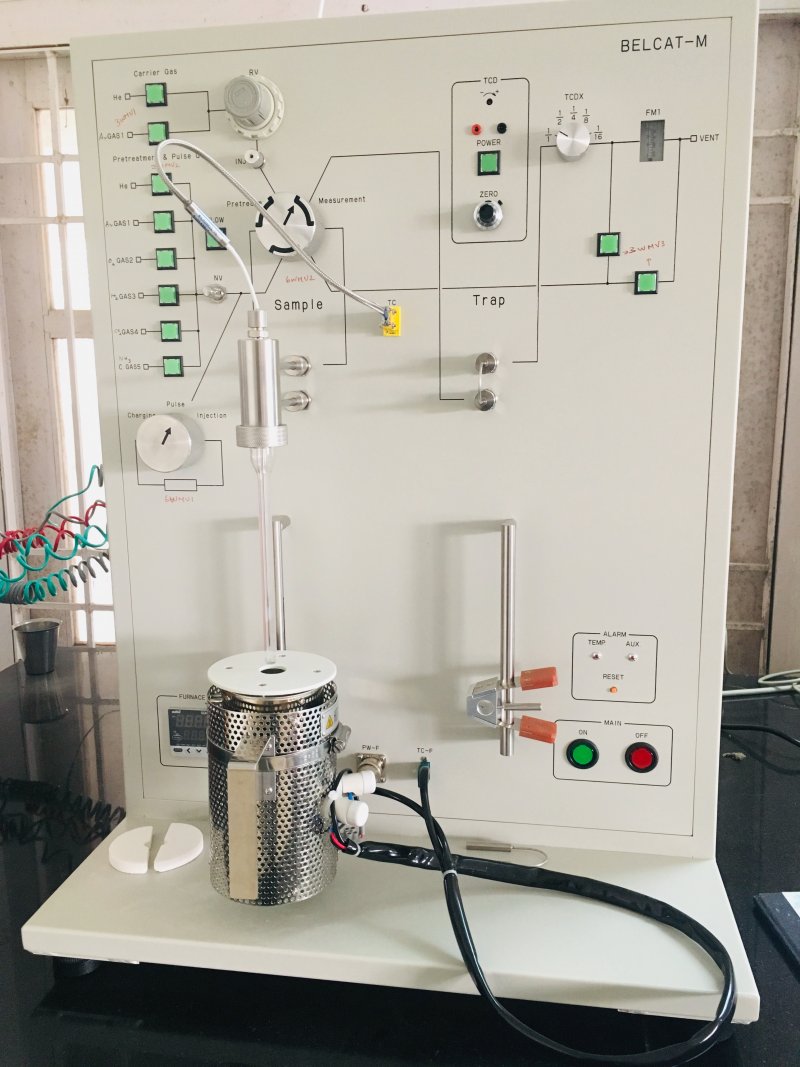
BELCAT-M
The BELCAT-M is the basic model of BELCAT series. The BELCAT-M is a compact and inexpensive instrument but provides a variety of measurements such as pulse chemisorption, TPD,
TPO/TPR and single point BET can be performed. Temperature control and data acquisition can be carried out by a high-resolution interface and the measurement software. Valves and other
parts are put on the front panel in a straightforward allay and that allows intuitive and easy operation.
The BELCAT-M is the basic model of BELCAT series.
           The BELCAT-M is a compact and an inexpensive instrument but provides a variety of measurements such as pulse chemisorption, TPD, TPO/TPR and single point BET can be performed. Temperature control and data acquisition can be carried out by a high-resolution interface and the measurement software. Valves and other parts are put on the front panel in a straight forward allay and that allows intuitive and easy operation.
SPECIFICATONS
 Measurement principle                                     Dynamic flow method                                                                                                                    
 Detector  Thermal Conductivity Detector (W-Re filament)

Gas port

Carrier / Pretreatment / Pulse

Pretreatment / Pulse

 
 2
 4
Gas flow control
Carrier / Pretreatment / Pulse
Pretreatment / Pulse

Needle valve
Needle valve
 
Electric furnace
Range
Ramp rate [50-500°C]                             
                                                                                                                                                
RT-1200°C�
100°C/min
 
 
FullSizeRender 36 1 1547634584 78005


Contact Us

CENTRAL SOPHISTICATED INSTRUMENTATION FACILITY (CSIF)
University of Calicut
Thenhipalam PO
Malappuram - 673635 PIN
 
Copyright © 2018 University of Calicut. All Rights Reserved | Powered By CUCC